
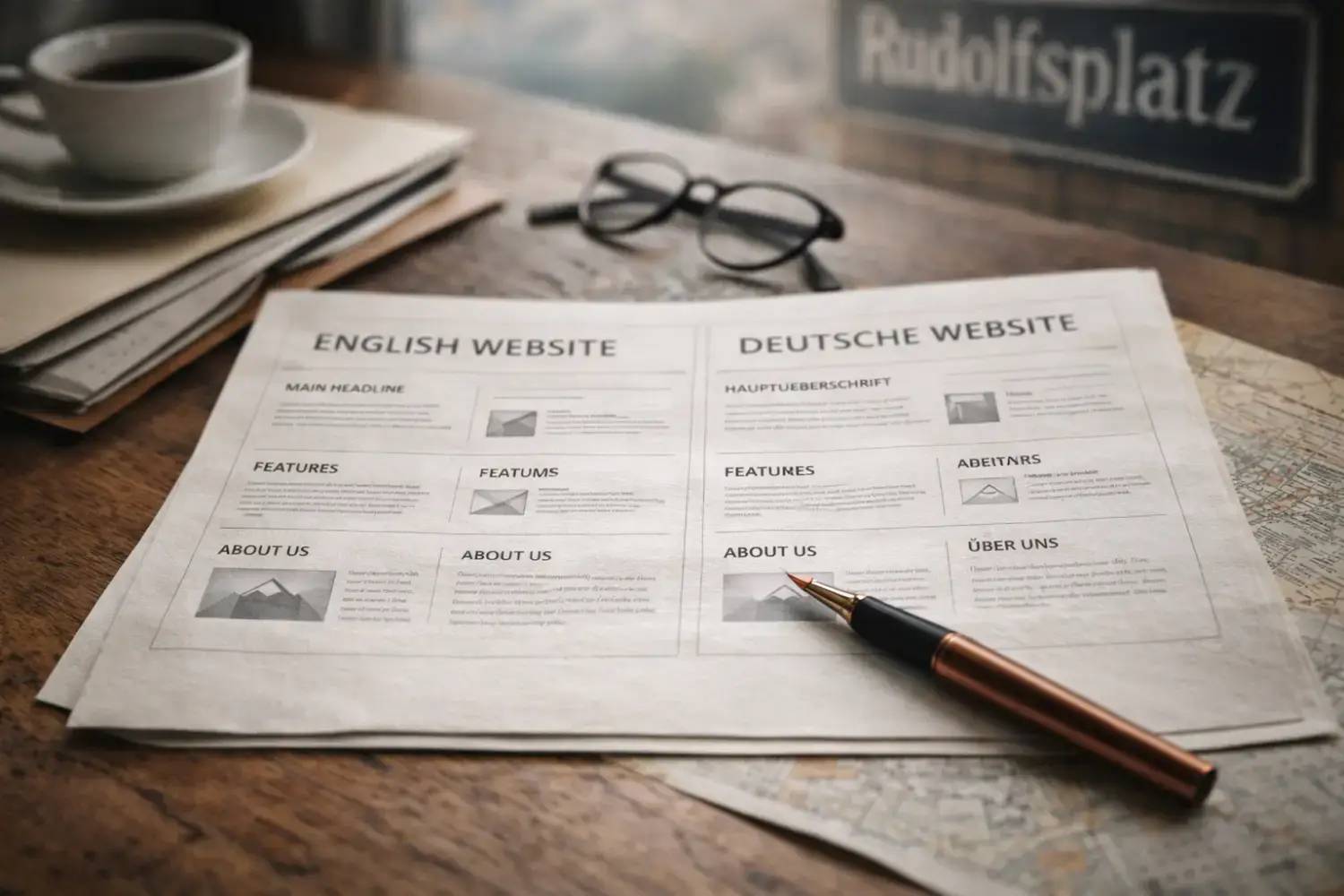
English Website Positioning in Austria
Structure, perception, and authority across markets
Founders building internationally often assume that if their website is written in English, it will function equally well everywhere.
After all, English is the language of global business.
The message is clear.
The expertise is visible.
Yet when that same website is presented within the Austrian business context, something subtle can change.
The communication still reads correctly.
But the perception of authority shifts.
What many founders underestimate is that a website does not communicate only through language.
It communicates through structure.
Hierarchy, sequencing, and emphasis quietly signal credibility long before a reader evaluates the words themselves.
An English website that performs well in global markets may therefore not automatically signal the same level of credibility within Austria.
Positioning is not only what you say.
It is how the information is ordered, framed, and weighted.
How English Positioning Is Interpreted in Austria
English-language business communication often foregrounds differentiation immediately. Positioning statements appear early. Claims are expressed with confidence. The tone emphasises momentum and clarity of direction.
Austrian business communication tends to move differently.
Authority is frequently established through context first. Arguments unfold with a measured sense of proportion. Expertise is demonstrated through structured reasoning rather than assertion.
When English website positioning is transferred directly into the Austrian context without adjustment, a subtle friction can appear.
The site may feel abrupt.
Or overly direct.
Or insufficiently grounded in context.
Nothing is linguistically incorrect.
But perception changes.
Website positioning in Austria therefore requires structural calibration rather than translation.
How Website Architecture Signals Credibility
Beyond language, the architecture of a website plays a decisive role in how expertise is perceived.
Hierarchy communicates priority.
Section order signals emphasis.
White space signals confidence.
Navigation signals clarity.
These elements quietly shape a reader’s interpretation long before they consciously evaluate the message.
For founders building across markets, the structure of the website must hold several expectations at once. It must maintain the clarity of English-led positioning while remaining intelligible and credible to German-speaking audiences.
This is where communication architecture intersects with website strategy.
When the structure of a website is thoughtfully designed, positioning feels intentional.
When the structure is improvised, even strong expertise can appear uncertain.
Visibility in an AI-Shaped Search Environment
Website structure now influences more than perception alone.
Search environments increasingly interpret patterns of coherence across content ecosystems. AI-mediated discovery evaluates topical depth, semantic alignment, and the structural relationships between pages.
Confidence alone does not generate visibility.
Structure does.
For founders building their presence in Austria, this means that English website positioning must also consider how search intent operates across languages.
Content clusters, internal linking, and conceptual clarity all contribute to how expertise becomes discoverable.
Website positioning therefore operates simultaneously at two levels: market perception and search visibility.
Both depend on the same foundation.
Structure.
Vienna as a Business Context
Vienna occupies a particular position within the European business landscape.
The city combines international connectivity with a long-standing institutional culture that values precision, proportion, and careful reasoning.
Innovation is respected here.
But credibility is often evaluated through structure rather than volume of claims.
When a website communicates with clarity and measured confidence, authority strengthens.
When the structure of the communication contradicts the positioning it intends to convey, doubt enters quietly.
This is why websites designed primarily for global English-speaking audiences sometimes require recalibration when they are intended to function within the Austrian market as well.
Positioning Across Languages
For founders building their work across English and German markets, website positioning cannot exist in isolation from bilingual brand alignment.
English communication often drives global reach.
German structural fluency anchors local credibility.
The architecture of the website must support both simultaneously.
This is not simply a design adjustment.
It is strategic positioning across markets.
The Strategic Distinction
Translation asks a straightforward question:
“How do we express the same message in another language?”
Website positioning in Austria asks a different one:
“How is expertise perceived within this context?”
For founders building their companies here, that distinction determines whether a website merely communicates information or actually builds authority.
When visibility exists but engagement remains limited, the issue is often structural rather than linguistic.
Recalibrating the architecture of the communication can restore clarity.
English Website Positioning in Austria
Language expresses expertise. Structure allows it to be trusted.
